Link to part1
We’ll cover the core segments and key public companies within each, including their recent performance, valuation posture, competitive moat, and how they’d fare if AI spending slows.
🧠 1) AI Chips & Accelerators — The Core Compute Layer
NVIDIA (NVDA) — The Dominant Leader
- 2025 Revenue: ~$130.5B (+114% YoY) with Data Center > $100B; Data Center revenue surging over 400% in the latest quarter.
- Margins: ~75% gross, ~55% net — exceptionally high for hardware.
- Growth Drivers: Blackwell/H200 GPUs, software ecosystem (CUDA), hyperscaler demand.
- Valuation: Premium — forward P/E ~33–53× and EV/Sales ~19×; high multiples reflect expected long-term AI expansion.
- Moat:
- Ecosystem lock-in through CUDA (developers building on Nvidia libraries).
- Brand leadership in performance and time-to-market.
- Diversification: Low outside AI compute. High exposure means earnings swing with hyperscaler capex — making it powerful but also cyclical if AI capex slips.
Summary: Nvidia is the engine of AI compute with unmatched growth — but its valuation is priced for perfection. Any slowdown in hyperscaler spending can amplify volatility.
👉 If AI demand slips, NVDA’s high multiples make it more sensitive than diversified players.
AMD (AMD) — A Growing Challenger
- Data Center Growth: Management forecasts data-center revenue growth of ~80% annually in coming years.
- 2025 Trends: Rapid expansion in EPYC CPUs + Instinct GPUs; multi-GW commitments from OpenAI.
- Valuation: ~41× forward P/E — lower than NVDA but still rich; reflects growth expectations.
- Moat:
- Architecture breadth (CPUs + GPUs).
- Multi-customer footprint across AWS, Meta, Oracle, and others.
- Diversification: Medium — enterprise + gaming CPUs balance cyclical data-center GPU demand.
- What’s overlooked: AMD’s server CPU share bolsters non-GPU revenue — a diversification edge vs pure GPU vendors.
Comparison vs NVDA: NVDA’s compute share and margins are higher, but AMD’s multi-product mix gives an earnings cushion if AI growth decelerates.
Micron Technology (MU) — Memory Powerhouse
- 2025 Performance: Record revenue ~50%+ YoY; HBM/DRAM revenue multiples expanding quickly.
- Valuation: ~9–10× forward P/E — much cheaper than peers, even as growth accelerates.
- Growth Drivers:
- HBM (High-Bandwidth Memory): Essential for AI GPUs/accelerators.
- Partnerships with NVDA + AMD.
- Margins: HBM business boosted gross margins from ~22% to >50% recently.
- Moat:
- Scarcity in HBM capacity worldwide.
- Deep technical integration with AI compute stacks.
- Diversification: Medium — memory also sells into PCs and mobile, cushioning cyclical downturns.
Key Insight: MU’s combination of massive growth, valuation discount, and critical tech means it can outperform big-chip peers if memory pricing remains firm.
🌐 2) Networking & Interconnect — The Nervous System
Arista Networks (ANET) — High-Speed Switch Leader
- 2025 Financials: ~30%+ revenue growth; earnings up ~38%.
- AI Role: Switches that tie GPUs and servers into clusters are mission-critical for performance.
- Moat:
- Strong relationships with hyperscalers (Microsoft, Amazon, Google).
- Product roadmaps tied to AI cluster needs.
- Valuation & Risk: Premium valuation due to growth expectations. If AI builds slow, interconnect demand lags after compute, leading to temporary bumps.
Cisco Systems (CSCO) — Diversified Networking & Security
- 2025 Revenue: ~$56.7B with double-digit product order growth.
- Moat:
- Incumbent in enterprise networking.
- Recurring revenue from security & software.
- Diversification: High — sells beyond AI into routers, security, and services.
- AI Edge: Integrated AI networking products but not as dependent on hyperscaler AI builds as Arista.
Summary: Cisco is a safe networking play that benefits from AI indirectly but won’t crater if AI builds slow.
⚡ 3) Infrastructure — Power, Cooling, Chassis
Vertiv (VRT) — Critical DC Infrastructure
- 2025 Growth: Stock up ~43% on AI data-center demand. Q3 revenue ~$2.7B, earnings +63%, guidance still strong.
- Product: UPS, cooling (liquid & precision), racks.
- Moat:
- Specialized hardware essential for high-density AI clusters.
- Diversification: Medium — also serves non-AI DCs and enterprise.
- Risk: More cyclic because demand tied to new builds.
Vertical Reflection: A pure infrastructure play — high beta to data-center construction cycles. Best choice when capex is booming.
nVent Electric (NVT) — Electrical Distribution
- 2025 Results: ~25–28% revenue growth, net income +84% on DC-related projects.
- Moat:
- Niche electrical components critical for power delivery.
- Diversification: Better than Vertiv — sells components across industries beyond data centers.
Bullish Angle: Often under the radar — strong growth but smaller cap. Good way to play electrical buildouts.
Amphenol (APH) — Connectivity & Cabling
- 2025 Performance: Stock +95%; Q3 revenue ~$6.2B, earnings +86%.
- Moat:
- Massive scale and broad product lineup.
- Essential connectors/fiber for servers & networking.
- Diversification: High — sells into aerospace, automotive, mobile, and telecom.
- Undervalued Aspect: Connectivity gear is critical but overlooked by many AI investors.
🏢 4) Cloud & Data Center Owners
Equinix (EQIX) & Digital Realty (DLR) — Data Center REITs
- Equinix: Long-term demand driven by colocation + cross-connect services.
- Issue: 2025 revenue and growth forecast disappointed, with slower near-term growth expectations.
- Capital Intensity: High — data center expansions require big capex.
- Moat:
- Global footprint, connectivity, long-term leases.
- Risk: If hyperscalers slow synthetic demand, leasing might lag — but diversified tenant bases reduce risk.
📊 5) Big Cloud Providers (AI Hosts + Brokers of Demand)
Microsoft (MSFT) / Amazon (AMZN) / Alphabet (GOOGL)
- All three are amid gigantic cloud and AI capex cycles; Azure and AWS have sustained growth rates ~30–40%+.
Moats & Risk:
- Very diversified: software, ads, e-commerce (for AMZN), productivity tools (MSFT), search (GOOGL).
- Cloud is just one piece of the business — less risky if AI demand cools.
- These are demand generators, not infrastructure suppliers, making them core players but less direct “picks & shovels.”
🤝 Valuation & Diversification Summary
| Company | Segment | Growth | Valuation | Diversification | Moat Strength |
|---|---|---|---|---|---|
| NVDA | GPU | 🚀 Very High | Premium | Low | Very Strong |
| AMD | CPUs/GPUs | 🚀 High | High | Medium | Strong |
| MU | Memory | 🚀 High | Cheap | Medium | Strong |
| ANET | Networking | High | High | Medium | Strong |
| CSCO | Networking | Moderate | Reasonable | High | Moderate |
| VRT | DC Infrastructure | High | Mid | Medium | Niche |
| NVT | Electrical | Moderate | Attractive | Medium | Niche |
| APH | Connectors | High | Mid | High | Diversified |
| EQIX/DLR | Data Center REIT | Moderate | Utility-like | Medium | Global footprint |
| AMZN/MSFT/GOOGL | Cloud | Very High | Premium | Very High | Very Strong |
🧠 Key Takeaways for Investors
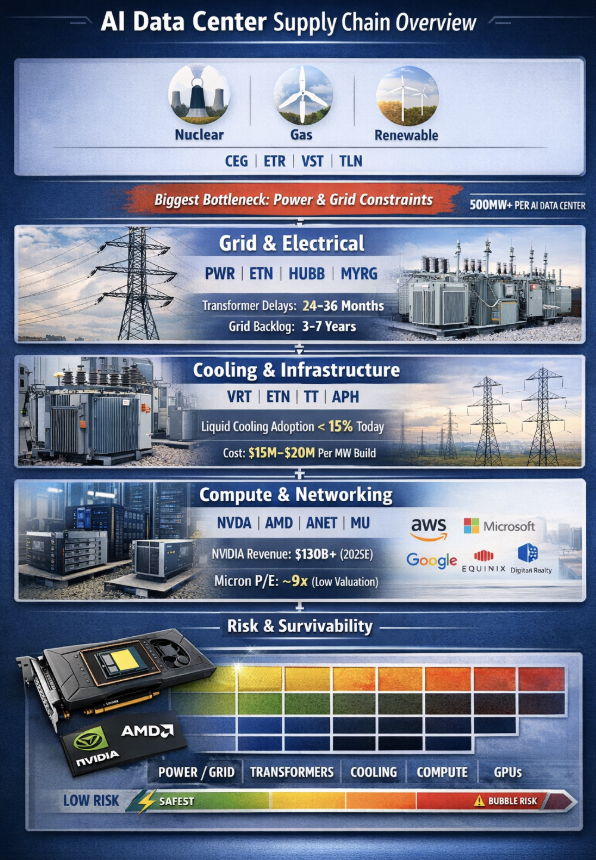
📌 Biggest Bottleneck Remains Power + Memory
- Memory (HBM) demand is tight; Micron’s price and production trajectory suggests potential supply shortages — a pricing tailwind for earnings.
📌 Compute Market Is Consolidated
- Nvidia still dominates the AI chip space but AMD is climbing. Both have different risk profiles (NVDA high growth, AMD better diversification).
📌 Infrastructure Players Offer Defensive Exposure
- Amphenol and Cisco may outperform pure AI names if growth slows because they sell into multiple industries.
📌 Cloud Providers Are Demand Base, Not Pure Infra
- MSFT/AMZN/GOOGL benefit as demand drivers — but AI slowdown would affect their cloud growth less severely than it would chip or infrastructure suppliers.
 Practical finance
Leave a comment